You are scrolling through your phone. Your thumb moves at a steady rhythm. Image. Image. Image. Then, suddenly, you stop.
Why?
Was it the highest resolution image? Probably not. Was it the most “beautiful” image in the traditional sense? Unlikely.
You stopped because of a subconscious psychological trigger.
In the digital economy, we do not trade in dollars; we trade in attention. If you are using AI tools like Midjourney or DALL-E to generate content for Pinterest, Instagram, or Ads, you need to understand one brutal truth. A pretty image is vanity. A clickable image is profit.
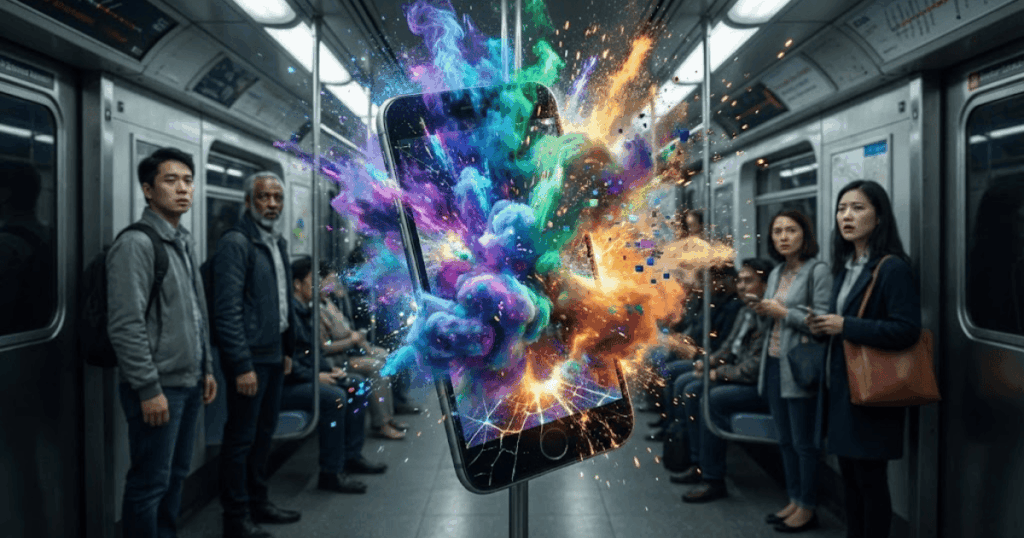
Most people use AI to create “cool” art. Strategists use AI to create psychological hooks.
If you want to turn your AI generations into money, you need to stop thinking like an artist and start thinking like a neuroscientist.
Here is the blueprint for creating images that physically force the user to stop scrolling.
The Economy of Attention (The 0.3 Second Rule)
The human brain processes visual data 60,000 times faster than text. When a user is scrolling a feed, their brain is in “filtering mode.”
It is actively looking for reasons to ignore content so it can conserve energy.
Your goal is to break this pattern.
You have approximately 0.3 seconds to register in the user’s brain. If your AI art looks like a generic stock photo, it gets filtered out.
To survive the filter, you must trigger a “Pattern Interrupt.”
Principle 1: The Pattern Interrupt (The “Wait, What?” Factor)
A Pattern Interrupt occurs when the brain sees something that defies its prediction. AI is perfect for this because it can blend concepts that do not exist in reality.
Don’t just prompt for “a luxury living room.” Prompt for “a luxury living room located inside a giant glass bubble underwater.”
The brain expects a living room. It does not expect the ocean.
That split-second of confusion (“Is that underwater?”) is where you win the click.
When generating images for your niche, ask yourself: What is the standard image in this category? Then, use AI to invert it.
If everyone is posting bright, sunny kitchens, post a moody, neon-lit kitchen. Contrast creates curiosity.
Principle 2: Color Psychology and The “Pop” Effect
Colors are not just decoration. They are instructions.
On platforms like Pinterest or Instagram, the background is usually white or black. If your image uses low-contrast pastels, it blends into the interface. You become invisible.
To stop the scroll, you need High Contrast.
- The Red/Orange Trigger: These colors create a sense of urgency and hunger. They are physically stimulating.
- The Blue/Green Trust: These create calm. They work for finance, but they rarely “shock” the eye.
Use your AI prompts to force extreme lighting conditions. Use terms like “volumetric lighting,” “bioluminescent,” or “high contrast shadows.”
This makes the subject pop off the screen.
Check what is trending visually on platforms like Pinterest Trends before you generate.
Principle 3: Emotion is in the Eyes
Humans are biologically wired to look at faces. Specifically, we look at eyes.
If your AI character has dead, empty eyes (the “1000-yard stare”), the user feels nothing.
The “Uncanny Valley” effect makes the viewer uncomfortable, and they scroll away.
You must prompt for specific emotions.
Do not just say “a woman.” Say “a woman with a skeptical expression,” or “a man crying tears of joy.”
This requires precise prompting. You cannot rely on the AI to guess the emotion; you must dictate the context.
For a deep dive on how to structure these instructions, read our guide on Contextual Prompt Engineering.
Principle 4: The Composition of Desire
Finally, consider the layout. On mobile screens (which is 90% of traffic), vertical space is premium real estate.
If you are generating for social media, always use a vertical aspect ratio (9:16 or 4:5).
A square image takes up less than half the screen. A vertical image takes up the full screen.
By physically occupying more pixels, you increase the probability of capturing attention.
It is a simple math equation that many creators ignore.
Your Strategy: The “Thumbnail Test”
Before you publish any AI art, perform the Thumbnail Test.
Shrink your image down to the size of a postage stamp.
Can you still understand what is happening?
Is the main subject clear?
Is the contrast strong enough?
If the image looks muddy or confusing at a small size, delete it. It will not convert.
AI gives you the power to generate 100 images in an hour.
Do not settle for the first one. Be the curator.
Pick the one image that creates a reaction in your gut. If it stops you, it will stop them.
Author’s Note: Now you have the text (Context) and the visuals (Psychology). In the next phase, we will discuss how to combine these assets into specific money-making vehicles. Join our Telegram Channel so you don’t miss the first strategy drop.